

Menopause & Women's Health
Expert, unhurried care for the years when your body stops behaving the way it used to.
Dr Hazel Parkinson | Named Best Menopause Specialist Doctor of the Year 2025
In person in Warwickshire, or online across the UK
You are not imagining it
Most women arrive here having already been told that their bloods are normal, that they are too young, that it is probably stress, or that they should come back in six months and see how they get on.
By then they have often been symptomatic for two or three years. They have stopped sleeping. They are exhausted, anxious in a way that feels unfamiliar, forgetting words in meetings, aching in joints that never used to ache, and quietly wondering whether this is simply what the rest of life is going to feel like.
It is not, and there is a great deal that can be done.
Dr Hazel is a GP with a specialist interest in women’s health who works in the NHS primary care gynaecology service, alongside her training with the British Menopause Society. She sees women in this position every week. The appointment lasts up to an hour, and the aim of it is to work out what is actually happening and what to do about it.
Symptoms
What perimenopause and menopause can look like
Menopause is not only hot flushes. Many women never have a single one. Symptoms often begin years before periods change, which is one reason perimenopause is so frequently missed.
Common symptoms include:
- Sleep that breaks at 3am, and exhaustion that sleep no longer fixes
- Anxiety, low mood, irritability or a sense of not feeling like yourself
- Brain fog, poor concentration and losing words mid-sentence
- Hot flushes, night sweats and palpitations
- Joint aches and stiffness, particularly in the morning
- Periods that become heavier, lighter, closer together or further apart
- Vaginal dryness, discomfort during sex, and loss of libido
- Urinary urgency, recurrent urine infections and bladder irritation
- Headaches or migraines that change pattern
- Skin that becomes dry, thin, itchy or suddenly spotty, and hair that thins
- Weight that shifts to the middle and will not respond to what used to work
If several of these are familiar, an assessment is worth having, whatever your age and whatever you have been told so far.
What Dr Hazel Treats
Menopause care
- Perimenopause and menopause assessment and treatment
- Hormone replacement therapy: starting, reviewing, adjusting and troubleshooting
- Women whose current HRT is not working, or who have had side effects
- Testosterone assessment for persistent low libido, energy and concentration
- Early menopause and premature ovarian insufficiency
- Surgical and medically induced menopause
- Vaginal dryness, discomfort and bladder symptoms
- Menopause where hormone treatment is not suitable or not wanted, including non-hormonal and lifestyle approaches
- Bone, heart and long-term health planning after menopause
- Menopause after cancer
- Menopause where there is a family history of breast cancer
- Menopause and skin, and menopause and weight, both areas where Dr Hazel can treat the whole picture rather than referring you elsewhere
Wider women’s health
- PMS and PMDD
- Heavy, painful or irregular periods
- Contraception advice, including what suits you approaching menopause
- Low libido and sexual wellbeing
- Recurrent thrush and bacterial vaginosis
- PMOS, previously known as PCOS: symptoms, hormonal skin changes and long-term health
- Hormonal acne, unwanted facial hair and hair thinning
What Happens at Your Consultation
What to expect
Before your appointment
You will be sent a detailed questionnaire covering your symptoms, medical history, family history and what you have already tried. Filling it in properly means the appointment is spent on you rather than on paperwork.
Your first consultation
Up to sixty minutes, in person at the clinic in Long Itchington or by video. There is time to tell the whole story, including the parts that feel difficult to raise. Dr Hazel will take a full history, discuss what is likely to be happening and why, and go through the options properly, including the risks and benefits and what the evidence actually says.
Tests
Not everyone needs blood tests. Menopause is usually a clinical diagnosis based on your symptoms and history, and hormone levels in perimenopause fluctuate so much that they are often unhelpful. Where tests are useful, for instance to check thyroid function, iron levels, or in younger women where the diagnosis is less certain, Dr Hazel will arrange them and explain what they show.
Your plan
Some women leave the first appointment with a prescription. Some need results back before anything is started. And some decide, having talked it through, that they would rather manage their symptoms without medication at all, in which case the plan is built around lifestyle measures instead. All three are entirely reasonable, and which one fits you is a decision made together rather than handed to you. Either way you will leave knowing what the plan is and what happens next.
Afterwards
With your consent, a letter goes to your GP so that your NHS record is accurate and your care stays joined up. Your first consultation fee includes one follow-up email if questions come up within eight weeks.
Follow-up
Hormone treatment almost always needs adjusting. Getting the dose, the route and the balance right takes a few months, and follow-up is where most of the fine tuning happens. It is worth planning for rather than hoping to avoid. Dr Hazel usually recommends a follow-up two to three months after starting treatment, and a second one about three months after that.
Why Dr Hazel
Why women choose Dr Hazel
NHS women’s health practice, not theory. Dr Hazel works as a GP with a specialist interest in women’s health within the NHS primary care gynaecology service, running alongside this clinic.
Formally qualified, and still training. DRCOG and DFSRH, Letters of Competence in intrauterine techniques and contraceptive implants, and training with the British Menopause Society which is ongoing. Member of the British Menopause Society and the Primary Care Women’s Health Society.
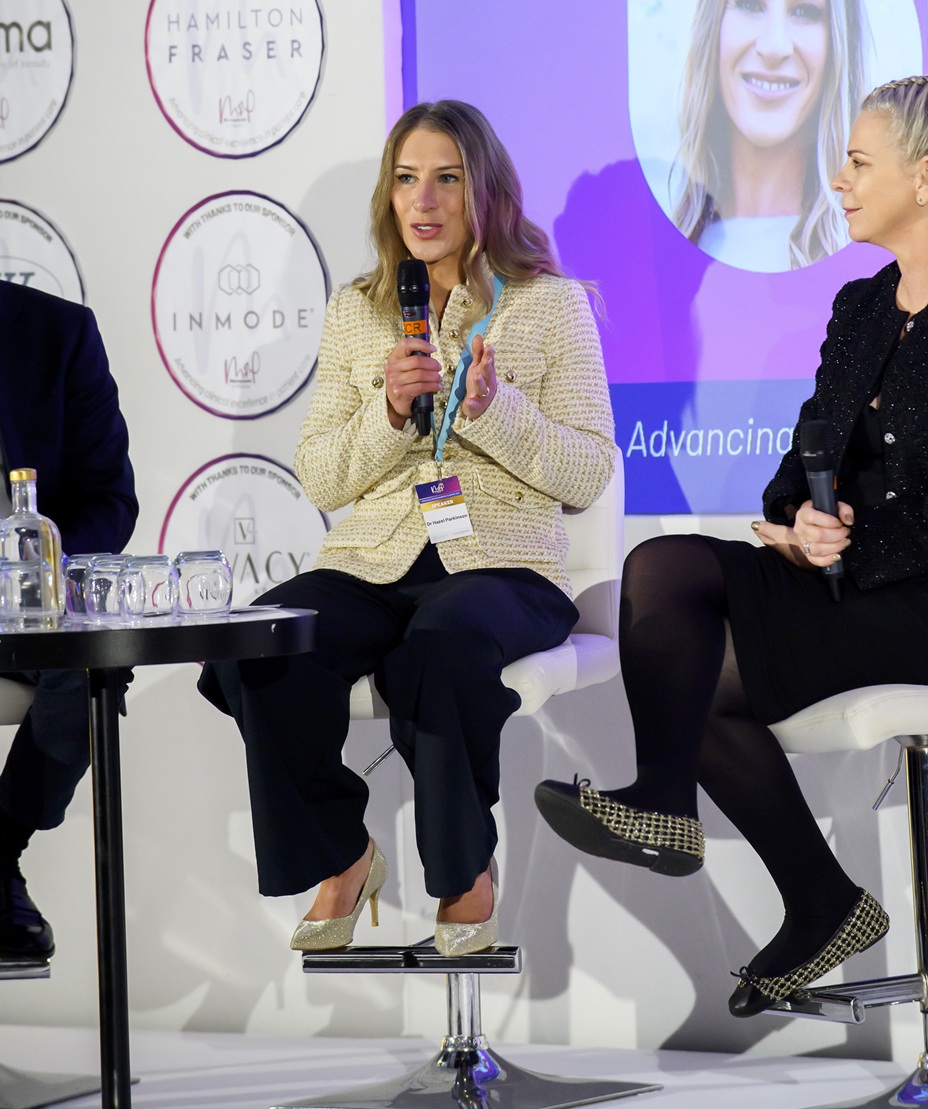
Nationally recognised. Named Best Menopause Specialist Doctor of the Year 2025 at the Menopause in Aesthetics Awards. Dr Hazel speaks at national conferences on menopause and women’s health, and campaigns publicly to raise awareness and push for better women’s health care.
Skin and hormones under one roof. Dr Hazel also holds a Postgraduate Diploma in Clinical Dermatology. Hormonal acne, thinning hair, unwanted facial hair and skin that has changed with perimenopause can be dealt with in the same place, by the same doctor, instead of becoming somebody else’s referral.
Time. Up to an hour for a first appointment. Most women say it is the first time anyone has heard the whole story.
Fees
- Menopause initial consultation, up to 60 minutes, in person or by video: £250
- Menopause follow-up, 30 minutes: £150
- Menopause initial consultation plus two follow-ups within six months: £450
- Women’s health initial consultation, 45 minutes by video: £175
- Women’s health follow-up, 30 minutes by video: £125
All consultation fees include a prescription where one is needed and a letter to your GP with your consent. Medication is charged separately by the pharmacy.
Ongoing menopause care is available at £29 per month once you have completed your initial consultation and two follow-ups.
Get in Touch
We are always on hand to answer any questions you may have about our treatments.
Book a Consultation
Appointments are available at the clinic in Long Itchington, Warwickshire, or by video anywhere in the UK.
If you are unsure whether you need a menopause consultation or a women’s health consultation, book either and it will be sorted out at the appointment. Nobody is going to be turned away for choosing the wrong one.
Frequently Asked Questions
Am I too young for this to be menopause?
Probably not. Perimenopause commonly begins in the early forties and can start in the thirties. Symptoms often appear years before periods change, which is why so many women are told they are too young when they are not.
Will I need a blood test?
Often not, and rarely to make the diagnosis itself.
In women over 45, perimenopause and menopause are diagnosed on symptoms and history. Hormone levels swing so widely during perimenopause that a single reading tells you very little, which is why a normal result is such a common and such an unhelpful answer.
Blood tests are genuinely useful for other things, and Dr Hazel will arrange them where they will change something. That includes:
- Confirming the diagnosis in women under 40, where premature ovarian insufficiency needs to be identified
- Ruling out other causes of the same symptoms, such as thyroid problems, anaemia or vitamin deficiency
- Investigating fatigue, hair loss or unexplained weight change
- Checking iron levels and how well you are absorbing it
- Establishing baseline markers before starting treatment
- Monitoring treatment, which is required for anyone taking testosterone
- Looking at bone, cardiovascular and metabolic health in midlife, which is a good deal more useful than a hormone level – please just change to Looking at bone, cardiovascular and metabolic health in midlife.
Blood tests are charged separately from your consultation.
Will I get a prescription at my first appointment?
Sometimes. It depends on your history, and on what you decide together.
Some women leave with a prescription that day. Some need results back first. And some choose to manage their symptoms through lifestyle measures rather than medication, in which case there is no prescription at all and the plan looks quite different. Dr Hazel will talk you through the options rather than assuming which one you want.
Where a prescription is issued, the cost of writing it is included in your consultation fee. The medication itself is paid for at the pharmacy.
What kind of HRT do you prescribe?
For most women who choose to try HRT, Dr Hazel’s first choice is body identical HRT. These are regulated products, authorised by the MHRA, whose molecules are identical to the hormones your ovaries produce. For the large majority of women it is currently both the most effective option and the one with the best safety profile.
Other preparations, including older synthetic types, are occasionally the better choice for a particular woman. If that applies to you, it will be explained fully before anything is prescribed. Everything Dr Hazel prescribes is a regulated, authorised product.
My GP has already started me on HRT but I still feel awful. Can you help?
Yes, and this is one of the commonest reasons women come. Being on treatment is not the same as being on the right treatment, at the right dose, by the right route, with the right progestogen. Reviewing and adjusting is a large part of the work here.
How long before I feel better?
Some women notice a difference within a few weeks. For most it takes around three months to feel the full benefit, and needing an adjustment along the way is normal rather than a sign that something has gone wrong. This is exactly why follow-up matters, and why Dr Hazel recommends a review two to three months in.
What if I cannot take HRT?
There is still a great deal that can be done, and it is not a consolation prize.
Non-hormonal prescribed treatments, targeted local treatment for vaginal and bladder symptoms, and evidence-based lifestyle work can all make a substantial difference to how you feel. These are part of the conversation for every woman, not just those who cannot take hormones.
I have had breast cancer, or it runs in my family. Can you help?
If you are having treatment for breast cancer, or have had it in the past, menopause can feel considerably more complicated than it already is. That does not mean nothing can be done.
Dr Hazel takes a detailed, individual approach in this situation, and is always glad to liaise with your oncologist or breast team so that what is recommended is right for you specifically rather than right in general.
A family history of breast cancer is a different question again, and often far less restrictive than women expect. It is worth having the conversation properly rather than assuming the answer.
Do you offer coils, implants or smear tests?
Not at this clinic. Dr Hazel fits coils and implants regularly in her NHS work, so she can advise you on what would suit you, but the procedures themselves are not carried out here.
If you need a coil as the progestogen part of your HRT rather than for contraception, that distinction matters and is frequently misunderstood. Dr Hazel can help you arrange it. She will ask whether your GP surgery fits coils, and if not, ask them to refer you to the NHS primary care gynaecology service. If you would rather go privately, she can refer you to a colleague who does.
For contraception alone, your GP surgery or local sexual health service can arrange fitting. Smear tests are available through the NHS cervical screening programme.
For practical questions about prescriptions, blood tests, appointments and fees, please see the Support page.